This article may contain affiliate links. If you book or buy through these links, we may earn a commission at no extra cost to you. This does not affect our recommendations.
Last fact-checked: 28 July 2026. Store counts, ATM rules and prices change — check anything that affects your budget or your cash on the day.
Almost every guide to Japanese convenience stores is a list of snacks. That is the least useful thing about them.
What a konbini actually is, for a visitor, is infrastructure. It is the reason you can land at 10pm and still eat. It is where you get cash when your card does not work at the ramen shop. It is the toilet that is always open, the umbrella when it starts raining, and the machine that sends your suitcase to your next hotel so you do not drag it onto a rush-hour train. There are over 55,000 of them, and the odds are extremely high that one is within a three-minute walk of wherever you are standing.
That last part is worth thinking about before you book a hotel, not after. Most first-time visitors evaluate a hotel on the station it is near. Residents also quietly check what is on the ground floor and the corner. This guide covers both: what to buy, and everything else the store does that nobody tells you about.
The short version
- 7-Eleven for cash, FamilyMart for fried chicken, Lawson for anything sweet. That is the honest three-line summary.
- 7-Eleven ATMs take foreign cards, run in English, and are open 24 hours. This is the single most useful fact in this article.
- You will be asked three questions at the register: heat it up? chopsticks? bag? Learn to nod at the first two and refuse the third.
- Eating in costs more. Takeaway is taxed at 8%, eating at the store’s counter at 10%. The staff are not being nosy.
- There are almost no public bins in Japan. The konbini bin is for things you bought at that konbini. This one matters more than it sounds.
- The Three Chains, and What Each Is Actually Best At
- What to Actually Buy
- How to Pay, and the Three Questions You Will Be Asked
- The Things That Are Not Food
- Four Mistakes Visitors Make
- Does Your Hotel Have One Nearby?
- Frequently Asked Questions
- Are Japanese convenience stores really open 24 hours?
- Can I pay by credit card?
- Is konbini food actually good, or is that a meme?
- How much should I expect to spend?
- Can I get cash at any convenience store?
- Can I buy alcohol at any hour?
- Do I need to speak Japanese?
- What is the one thing I should try first?
The Three Chains, and What Each Is Actually Best At
About 90% of Japan’s convenience stores belong to three companies, and while they look interchangeable from the street, regular customers here have firm opinions about which one to walk the extra block for. The differences are real, and they are almost entirely about the prepared food.
| Chain | Stores (2026) | Go here for | Honest verdict |
|---|---|---|---|
| 7-Eleven | 21,000+ | Cash withdrawal, onigiri, the egg sandwich, coffee | The default. If you only learn one, learn this one — the ATM alone justifies it. |
| FamilyMart | ~16,000 | Famichiki (fried chicken), hot case items | Worth crossing the road for the hot counter. Nothing else is meaningfully better. |
| Lawson | ~14,000 | Desserts, Karaage-kun, the bakery shelf | The one to pick if you want something sweet. Its dessert range is not close to being matched. |
You will also see Ministop (has soft-serve ice cream and actual seating) and NewDays (inside JR stations, useful for grabbing food before a train). Neither is worth a detour, but both are worth knowing by sight.
🏠 Local note
The rivalry is genuine and low-stakes. Ask people here which konbini they prefer and you will get an immediate, confident answer with reasons — usually about one specific product. It is a completely normal small-talk topic, and it is a good one to have with hotel staff or a bar counter neighbour, because it costs nothing and everyone has a position. Mine, for what it is worth: Lawson for the dessert shelf, 7-Eleven for everything else.
What to Actually Buy
The useful way to think about konbini food is not “what is famous” but “what problem am I solving right now”. There are four situations you will genuinely hit on a first trip.
You landed late and everything is closed
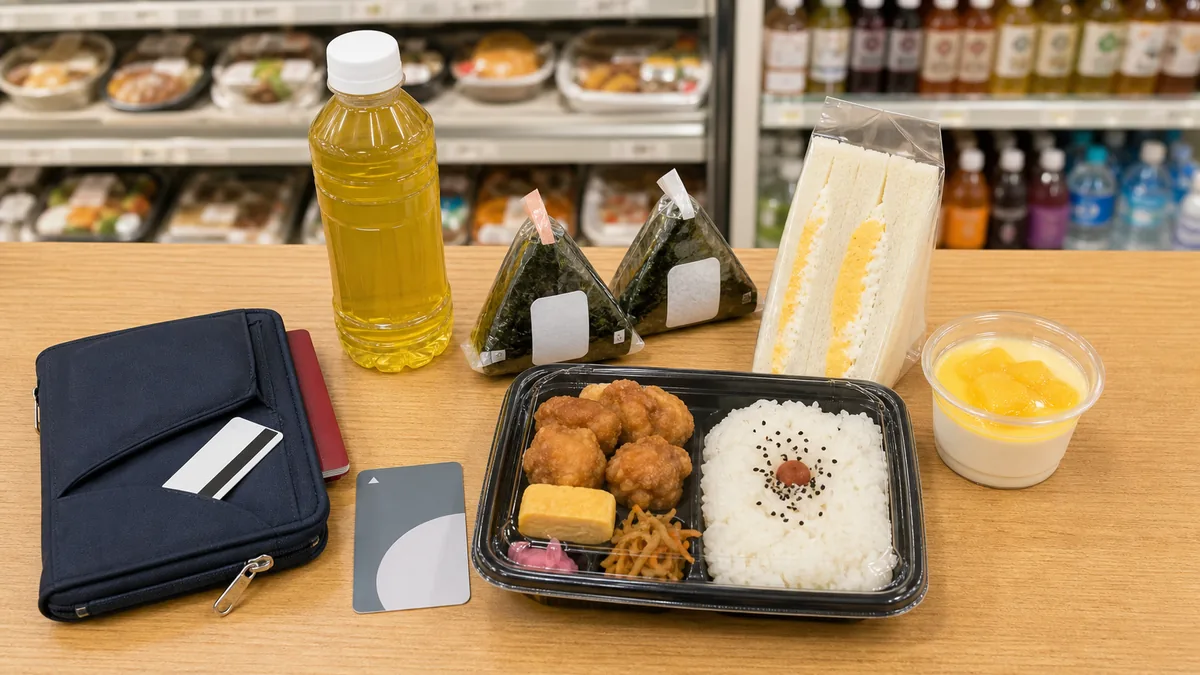
This is the classic one, and the konbini handles it completely. Go for a bento (a boxed meal — rice, a protein, some vegetables) and say yes when they offer to heat it. Add a bottle of green tea. You will eat better than you would at most airport restaurants, and you will do it at 11pm.
If you want something hot and immediate instead, the hot case by the register is the answer — FamilyMart’s Famichiki and Lawson’s Karaage-kun are the two items with genuine cult status, and both are fried chicken handed over in a paper sleeve. They are not health food and they are not subtle. They are very good.
Breakfast, because your hotel charges too much for it
Onigiri — rice triangles wrapped in seaweed — are made fresh daily, cost very little, and are the single best-value item in the store. Tuna mayo (sea chicken) and salmon (shake) are the safe first choices; umeboshi (pickled plum) is a much stronger flavour than most visitors expect, so try it second rather than first.
The wrapper is engineered so the seaweed stays crisp until you open it, and it defeats a lot of people. Follow the numbers printed on the packaging:
How to open an onigiri without destroying it
- Pull the tab marked 1 straight down the middle. The wrapper splits in two.
- Pull side 2 out sideways, away from the rice.
- Pull side 3 out the same way. The seaweed wraps itself around the rice as you go.
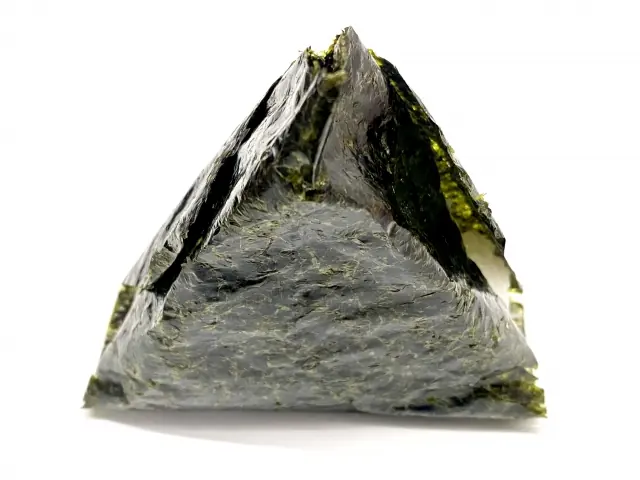
The other breakfast item worth your attention is the egg sandwich — crustless white bread with a thick, almost custardy egg filling. It has an outsized international reputation for something that costs a couple of hundred yen, and the reputation is deserved.
You have a long train ride
Buy before you board, not on board. A bento, an onigiri or two, a drink, and something from the dessert shelf covers a two-hour ride comfortably. Note that eating on a long-distance train (a shinkansen or a reserved-seat express) is completely normal and expected; eating on a local commuter train is not. The distinction is about the type of train, not the food.
You want to try the thing that changes seasonally
From roughly autumn through winter, most stores put out oden — a vat of fish cakes, daikon radish, boiled eggs and tofu simmering in a light broth by the register. You point at what you want and they ladle it into a container. It is one of the few genuinely local, genuinely seasonal things you can buy at 2am for pocket change.
The other seasonal thing to watch is the dessert shelf, which turns over constantly and leans hard into whatever fruit is in season. If you see something with sakura, chestnut or white peach on it, that is a limited run and it will not be there next month.
⚠️ Vegetarian? Read the guide first, not the label.
Konbini food is difficult on a plant-based diet in a way that is not obvious from packaging. Fish stock and bonito flakes appear in a great many savoury items, including things that read as vegetable-based. Your safest options are plain onigiri fillings, fruit, bread from the bakery shelf, and yoghurt. We cover the underlying problem — and the phrase that actually works — in How to Order Food in Japan.
How to Pay, and the Three Questions You Will Be Asked
The register interaction is short and almost entirely predictable. Staff will ask up to three things, in roughly this order.
| What you will hear | What it means | What to say |
|---|---|---|
| Atatamemasu ka? | Shall I heat this up? | Onegaishimasu (yes please) or daijoubu desu (no thanks) |
| Ohashi wa? | Do you want chopsticks / a spoon? | Nod, or daijoubu desu if you do not need them |
| Fukuro wa? | Do you want a bag? Bags are charged for. | Say daijoubu desu and use your own |
You may also be asked to tap a button on the customer-facing screen confirming you are of age. This happens with alcohol and tobacco, it is a legal requirement, and it is not the cashier doubting you — the button appears for everyone, including people obviously in their sixties. Tap it and move on.
Payment is easy: cards, IC cards (Suica, ICOCA, Pasmo) and the major QR apps all work, and konbini are among the most reliably cashless places in the country. That is the opposite of the small independent restaurants you actually want to eat at, most of which are cash-only — which is exactly why the ATM matters so much.
⚠️ “Eat in or take away?” is a tax question
Some stores have a small counter with stools. If you tell them you are eating there, the tax on your food goes from 8% to 10%, because eating on the premises is legally a restaurant service and taking it away is groceries. The difference is small in absolute terms, but the question confuses a lot of visitors who assume they are being told off. They are not. Answer honestly and pay the difference, or take it outside.
The Things That Are Not Food
This is the part that separates a konbini from a corner shop anywhere else, and it is the part almost no travel guide covers properly.
| Service | What you need to know |
|---|---|
| ATM (foreign cards) | 7-Eleven’s Seven Bank ATMs accept the major international networks, run in English and other languages, and are open 24 hours. Lawson Bank ATMs also take foreign cards, but not every Lawson has one. This is the most reliable way to get yen in Japan. |
| IC card top-up | Hand your Suica or ICOCA to the cashier with cash and say the amount. Faster than queuing at a station machine. Topping up is cash only — you cannot charge an IC card with a credit card here. |
| Luggage forwarding | You can send a suitcase from a konbini to your next hotel, usually arriving the following day. Konbini handle outbound only — you cannot have it delivered back to a store. Costs depend on size and distance. |
| Printing | The multi-function copier prints from a USB stick or your phone. Useful for a boarding pass, a hotel voucher, or a ticket a venue insists on having on paper. |
| Toilets | Usually available and usually clean. Ask rather than walking straight through: toire, ii desu ka? Buying something afterwards is normal courtesy, not a rule. |
| Free Wi-Fi | Available at most stores, but it needs a registration step the first time and it is slow. Treat it as a fallback, not a plan — see our eSIM guide for the thing you should actually arrange before you fly. |
| Umbrellas | Clear plastic, cheap, sold at the front of the store the moment it starts raining. Half the people you see with one bought it in a hurry from a konbini. |
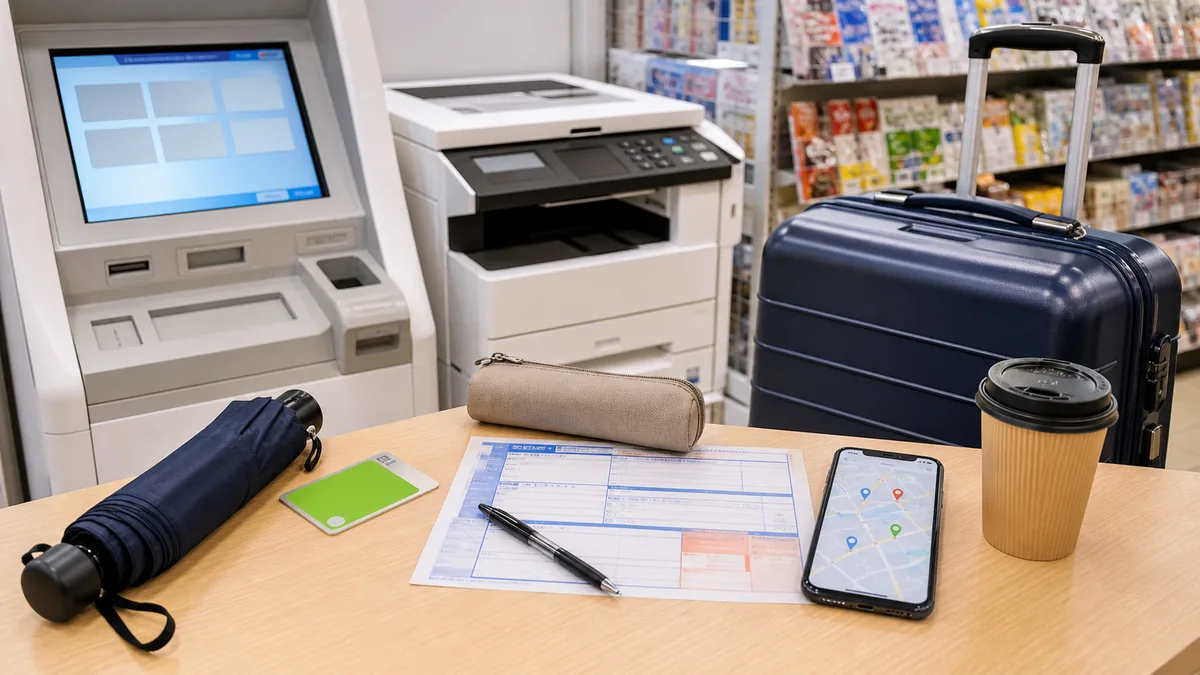
🏠 Local note — why this feels different from a corner shop at home
Living in Nara, I use a konbini most days, and almost never for a meal. It is where the parcel goes, where the bill gets paid, where cash comes from at 11pm. That is the mental model to copy. It also explains something visitors find funny: Japanese travellers abroad often go looking for a convenience store on their first evening in a new country and come back disappointed. They are not homesick for the snacks. They are looking for the utility — the assumption that one small shop can solve five unrelated problems at any hour — and it mostly does not exist anywhere else.
Four Mistakes Visitors Make
⚠️ Avoid these
- Using the konbini bin for outside rubbish. Japan has very few public bins, so the temptation is enormous. Those bins are for things bought at that store, and in some places they have been moved inside the door specifically because of this. Carry a small bag and take your rubbish back to your hotel — that is what residents do.
- Eating while walking. Not illegal, but conspicuous. Finish it standing near the store, or at the counter inside. In some tourist-heavy shopping streets it is explicitly discouraged by signs.
- Assuming any ATM will take your card. Plenty of Japanese bank ATMs will simply reject a foreign card with no useful explanation. Go to 7-Eleven first and save yourself the loop.
- Treating it as your main food plan. It is genuinely good, and it will quietly eat three days of your trip if you let it. The best eating in Japan is in shops with six seats and no English menu — see what to eat in Osaka for what you would be missing.
Does Your Hotel Have One Nearby?
This sounds trivial and it is not. On a first trip you will arrive late at least once, you will want breakfast before the hotel restaurant opens at least once, and you will need cash at an awkward hour at least once. A store on the corner solves all three; a store fifteen minutes away solves none of them.
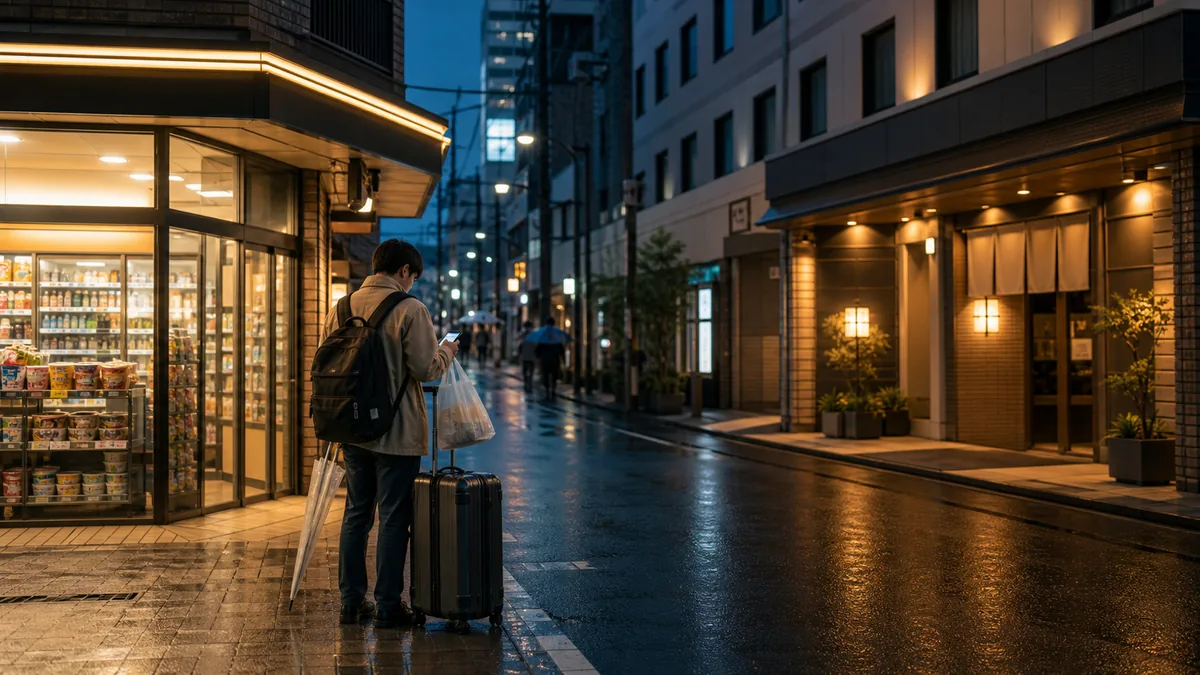
In practice this is rarely a constraint in central Kansai — the density in Namba, Umeda, central Kyoto and around the major stations is high enough that you can assume coverage. It becomes a real question when you stay somewhere quieter for the atmosphere: residential Kyoto, the edges of Nara, or a ryokan outside a town centre. Those are lovely places to stay and they are exactly where the 11pm assumption breaks.
If you are still deciding where to base yourself, we have written the area comparisons in detail:
- Namba or Umeda? — the Osaka question everyone asks first
- Where to stay in Kyoto — by what you actually want your days to look like
- First day in Osaka: KIX to Namba — including what to do about food when you land at night
Frequently Asked Questions
Are Japanese convenience stores really open 24 hours?
Most are, especially in cities and near stations. It is no longer universal — some suburban and rural branches now close overnight because of staffing. In central Osaka, Kyoto or Nara you can assume 24 hours; further out, check the door.
Can I pay by credit card?
Yes. Konbini are among the most reliably card-friendly places in Japan, and they also take IC cards and the major QR payment apps. This is the exception rather than the rule in Japan, which is why you should still carry cash for everywhere else.
Is konbini food actually good, or is that a meme?
It is genuinely good, with a real ceiling. The onigiri, sandwiches and desserts are excellent for what they cost. The bento are decent and convenient rather than memorable. It is a very high floor, not a high peak — which is exactly what you want at 11pm and not what you want on your one free evening.
How much should I expect to spend?
A full konbini meal — bento or sandwiches, a drink, something sweet — is comfortably the cheapest hot meal you can buy in Japan, and meaningfully cheaper than the equivalent in most Western cities. Prices vary by item and have moved in recent years, so treat the shelf price as the answer rather than anything you read in advance.
Can I get cash at any convenience store?
Not equally. 7-Eleven is the reliable answer for foreign cards; Lawson works at many branches; other stores vary. If you have a card that has failed elsewhere in Japan, a 7-Eleven ATM is the thing to try before you assume the card is the problem.
Can I buy alcohol at any hour?
Yes — beer, wine, spirits and canned chu-hai are sold alongside everything else, at any time, with only the age-confirmation tap. There is no nationwide ban on drinking in public, which is a genuine novelty for a lot of visitors — but some city districts have their own street-drinking rules, and signage will tell you. Read the room either way: a park or a riverbank is fine, a crowded commuter train is not.
Do I need to speak Japanese?
No. The whole transaction can be completed with nodding and pointing, and registers display the total in numerals. The three questions above are the only spoken part, and daijoubu desu covers most of them.
What is the one thing I should try first?
A tuna-mayo onigiri and an egg sandwich, bought at 7-Eleven, eaten within about ten minutes of landing. If you want the single most-discussed item instead, make it a Famichiki from FamilyMart.
Planning your first Japan trip? Get the free Japan Starter Guide — a simple checklist covering what to book before you arrive, where to stay in Kansai, and what most first-time visitors get wrong.
Get the Free Japan Starter Guide →
Next, read How to Order Food in Japan for the moment you leave the convenience store behind and walk into a shop with a ticket machine at the door — and what to book before your first Japan trip for everything that needs arranging before you fly.