This article may contain affiliate links. If you book or buy through these links, we may earn a commission at no extra cost to you.
If Kyoto is your first base after KIX, pair this area guide with First Day in Kyoto: Kansai Airport to Your Hotel so your first hotel, luggage move, and evening plan fit together.
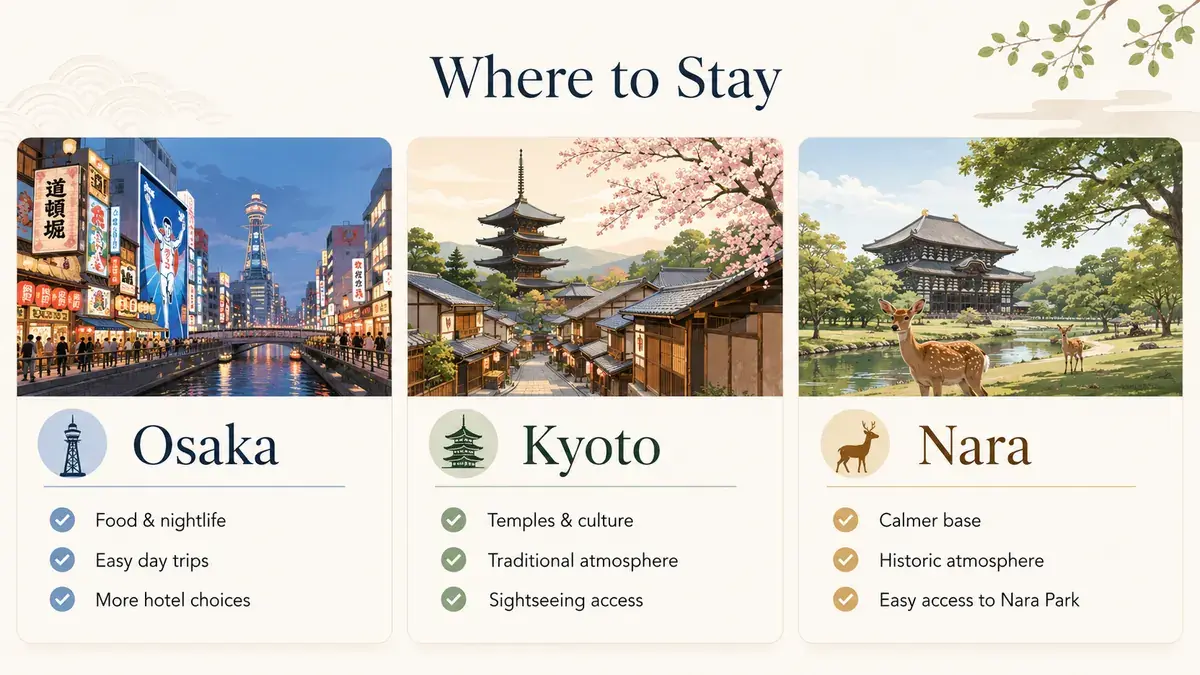
Quick answer: For a first trip of 5–7 days, the setup that works for most people is a split — a few nights in Osaka and a few in Kyoto, with Nara as a day trip. If you’d rather not change hotels at all, base in Osaka (Namba) and day-trip to everything.
Osaka, Kyoto, and Nara form a compact triangle — each pair is connected by direct trains of 35–50 minutes. That’s the good news: you genuinely cannot pick a “wrong” base that ruins your trip. But each city gives you a very different experience when the day-trippers go home, and that’s what this guide is really about.
The 30-second version
- 5–7 days, first visit → split it. 3–4 nights Osaka, 2–3 nights Kyoto, Nara as a day trip.
- One hotel only → Osaka (Namba). Kyoto is 30 min, Nara 39 min, the airport is a direct train.
- 7+ days or a second visit → add 1–2 nights in Nara. The evenings are the reason.
- Every leg of the triangle is under an hour and costs ¥410–¥760. You cannot pick a base that ruins the trip.
- City accommodation tax is charged at the property, per person per night, on top of what you prepaid. Kyoto’s went up sharply on 1 March 2026.
- The Triangle: How Close Are They Really?
- What the Triangle Actually Costs
- Staying in Osaka: Food, Energy, Convenience
- Staying in Kyoto: Atmosphere, Early Mornings, Calm
- Staying in Nara: The Contrarian Option (That I Love)
- The Three Setups That Actually Work
- The Tax Nobody Mentions Until You Check Out
- When to Book
- What to Book Before You Arrive (and What Not To)
- FAQ
- Is it better to stay in Osaka or Kyoto?
- Is Nara worth staying overnight?
- Can I do Kyoto as a day trip from Osaka?
- Where should I stay if I’m flying in and out of Kansai Airport?
- Which is cheaper overall, Osaka or Kyoto?
- Is one hotel change worth the hassle?
- Which station should I stay near in Osaka?
- Do I need a Japan Rail Pass for Kansai?
- Can I leave my luggage somewhere while I move between cities?
- Is Kobe or Himeji worth adding?
- Final Recommendation
The Triangle: How Close Are They Really?
| Route | Train | Time |
|---|---|---|
| Osaka (Namba) ↔ Nara | Kintetsu | ~40 min direct |
| Kyoto ↔ Nara | Kintetsu | ~35–50 min direct |
| Osaka ↔ Kyoto | JR special rapid | ~30 min direct |
Any of the three can be a base for the other two. So the question isn’t logistics — it’s what you want your evenings and mornings to feel like.
What the Triangle Actually Costs
The table above gives times; this one gives the fares and the trains you actually want, checked in July 2026. Note that the Kintetsu Limited Express is not a different route — it is the same line with a reserved-seat surcharge on top of the basic fare. On a 35-minute ride, that surcharge buys you a guaranteed seat, which matters more than it sounds in cherry-blossom season.
| Leg | Best train | Time | Fare |
|---|---|---|---|
| Osaka (Umeda) → Kyoto | JR Special Rapid | about 29 min | about ¥580 |
| Osaka-Umeda → Kyoto-Kawaramachi | Hankyu Limited Express | 43–48 min | ¥410 |
| Osaka-Namba → Kintetsu Nara | Kintetsu Rapid Express | 39 min | ¥680 |
| Osaka-Namba → Kintetsu Nara | Kintetsu Limited Express | about 30 min | ¥1,200–1,300 |
| Kyoto → Kintetsu Nara | Kintetsu Express | about 45 min | ¥760 |
| Kyoto → Kintetsu Nara | Kintetsu Limited Express | about 35 min | ¥1,280 |
| Kyoto → JR Nara | JR Miyakoji Rapid | about 45 min | about ¥720 |
⚠️ Nara has two stations and they are not the same place
Kintetsu Nara and JR Nara are different stations on different railways, about a 15-minute walk apart. Kintetsu Nara is the one you want: it puts you roughly 5 minutes from the edge of Nara Park and the first deer. JR Nara sits further west, in the quieter business end of town, and adds a 20-minute walk or a bus to everything you came for.
This trips people up constantly, because booking sites list both as “Nara Station” and because a Japan Rail Pass only covers the JR one. If you are carrying a rail pass, the JR route is free but you walk; if you are not, take Kintetsu. Check which station your hotel is actually near before you book, not after.
Staying in Osaka: Food, Energy, Convenience
What It’s Like
Osaka is Kansai’s engine room — loud, funny, delicious, open late. Staying here means ending every day with a proper dinner scene: Dotonbori neon, standing bars, okonomiyaki counters where the cook talks to you.
Why Base Here
- Best food and nightlife in Kansai, walkable from a Namba hotel
- Best transport hub: direct trains to Nara (Kintetsu), Kyoto (JR/Hankyu), Kobe, and Kansai Airport
- Best hotel value of the three — more rooms, more competition
- Feels alive at 10pm, when Kyoto’s sightseeing districts have gone quiet
The Trade-Off
Osaka itself has fewer must-see historical sights. You’ll spend your days traveling out and your evenings coming back — which is exactly why it works so well as a base.
Best areas: Namba for first-timers, Umeda if Kyoto is your priority. Full breakdown: Best Area to Stay in Osaka.
Choosing Osaka? Decide the neighbourhood before the hotel — in Osaka the area matters more than the property. Full breakdown: Best Area to Stay in Osaka →

Staying in Kyoto: Atmosphere, Early Mornings, Calm
What It’s Like
Kyoto in the evening and early morning is a different city from Kyoto at noon. Stay overnight and you can walk Higashiyama’s lanes before the tour buses arrive, or see Gion at dusk when it’s actually atmospheric.
Why Base Here
- Early access to the famous sights — Fushimi Inari at 7am is magical; at 11am it’s a queue
- The ryokan and machiya experience — traditional inns and townhouses are a Kyoto specialty
- Quieter, more beautiful evenings
- Direct trains to Nara (Kintetsu from Kyoto Station)
The Trade-Off
- Hotels cost more than Osaka for equivalent quality, and sell out first in cherry blossom and autumn seasons
- Dinner options thin out earlier; some neighborhoods are very quiet by 9pm
- Slightly less convenient for Kansai Airport (about 75–80 minutes on the Haruka)
Who should choose Kyoto: travelers whose trip is about temples, gardens, and traditional Japan — and anyone who wants one or two ryokan nights.
Choosing Kyoto? Read the local area guide before booking: Best Area to Stay in Kyoto →
For a short Kyoto leg, Downtown is the base that wastes the least of it. Neighbourhood-by-neighbourhood detail is in Best Area to Stay in Kyoto for First-Time Visitors.

Staying in Nara: The Contrarian Option (That I Love)
What It’s Like
Here’s what most guides won’t tell you, because most guide writers have only visited Nara as a day trip: Nara after 5pm is one of the best-kept secrets in Kansai.
The day-trip crowds leave on the evening trains. The deer are still in the park. Todai-ji’s grounds and the lantern paths of Kasuga Taisha go quiet. You can walk Naramachi’s old merchant streets in the early morning with almost nobody around.
Why Base Here
- Evenings and mornings you simply cannot get as a day-tripper
- Cheaper than Kyoto for traditional-style accommodation
- Calm, small-scale, walkable — a genuine antidote to travel fatigue
- Still connected: 40 minutes to Osaka, ~45 to Kyoto by Kintetsu
The Trade-Off
- Nara mostly closes early. Dinner options after 8pm are limited — this is the real constraint, and you should know it going in
- Fewer hotels overall; the best traditional inns book out early
- Using Nara as a base for both Osaka and Kyoto every day means a lot of train time
Who should choose Nara: second-time visitors, travelers who prioritize calm over nightlife, photographers, and anyone doing a longer trip who can give Nara 1–2 nights in addition to an Osaka or Kyoto base.
Honest advice for first-timers: don’t make Nara your only base. Make it a day trip — or better, add one overnight and experience the quiet evening the day-trippers miss.
Thinking about Nara overnight? Decide first whether Nara is a day trip or a slow overnight stop: Nara Day Trip from Osaka or Kyoto → If you are staying, book something walkable to the park rather than near the station car parks.

🏠 I live in Nara, so take this with the bias it deserves
Everything above about Nara being quiet after 5pm is true, and I still think most first-timers should not base their whole trip here. What I want you to understand is what closing early actually means. It is not that Nara is asleep at 8pm — it is that the restaurants around Sanjo-dori and Naramachi mostly take last orders between 20:00 and 21:00, and that if you turn up at 21:30 expecting Osaka, you will eat at a convenience store.
Plan dinner for 18:30, and the trade stops being a trade. What you get in exchange is Nara Park at 7am with mist coming off the grass and maybe six other people in it, and the walk up to Kasuga Taisha’s lanterns at dusk after the last day-trip bus has gone. I have walked that path hundreds of times and it still works on me. One night is enough to get it. Two is better.
The Three Setups That Actually Work
Setup 1: The Split (most popular for 5–7 days)
- 3–4 nights Osaka (Namba) + 2–3 nights Kyoto
- Nara as a day trip from either city
- You get Osaka’s food and Kyoto’s early mornings
- One hotel change, done mid-trip
Setup 2: The Single Base (easiest)
- All nights in Osaka (Namba)
- Day trips: Kyoto (30 min), Nara (40 min), Kobe (30 min)
- Zero packing/unpacking, best hotel value
- Trade-off: no early-morning Kyoto, no evening Kyoto
Setup 3: The Connoisseur (7+ days)
- 3 nights Osaka + 2–3 nights Kyoto + 1–2 nights Nara
- The full range: neon, temples, and silence
- Best for slower travelers who hate rushing
| Hotels | Food/nightlife | Early temple access | Calm | |
|---|---|---|---|---|
| Split | 2 | ★★★★★ | ★★★★☆ | ★★★☆☆ |
| Single base (Osaka) | 1 | ★★★★★ | ★★☆☆☆ | ★★☆☆☆ |
| Connoisseur | 3 | ★★★★★ | ★★★★★ | ★★★★★ |
The Tax Nobody Mentions Until You Check Out
Kansai cities charge an accommodation tax per person, per night, collected by the property rather than by the booking site. That means it appears on your bill at the desk even when you prepaid the room in full online. It is not a scam and it is not optional — but it does mean your Kyoto total is higher than the number you booked at, and this is one place where the three cities genuinely differ.
| City | Rate per person, per night | What it means for a typical first trip |
|---|---|---|
| Kyoto | ¥200 / ¥400 / ¥1,000 / ¥4,000 / ¥10,000 by nightly room rate, under the rates effective 1 March 2026 | Usually ¥400 per person per night. The highest in Japan at the top end. |
| Osaka | Exempt under ¥5,000; ¥200 up to ¥15,000; ¥400 up to ¥20,000; ¥500 above that | Usually ¥200 per person per night, and genuinely nothing on cheap rooms. |
| Nara | I could not verify a Nara city accommodation tax as of July 2026 | Check your booking confirmation rather than assuming either way. |
Practical version: for a couple splitting three nights in Osaka and three in Kyoto, expect roughly ¥1,200 in Osaka and ¥2,400 in Kyoto on top of the room rates. Carry some cash for it — smaller properties still ask for the tax in cash even when the room went on a card.
When to Book
Kansai hotels genuinely sell out — not “get expensive,” sell out — during:
- Late March – early April (cherry blossom)
- Golden Week (late April – early May)
- November (autumn colors, Kyoto especially)
For those windows, book accommodation 3–6 months ahead. The rest of the year, 1–2 months is comfortable. Hotels belong near the top of your pre-trip booking checklist, right after flights.
What to Book Before You Arrive (and What Not To)
Kansai needs far less advance booking than people expect. Temples and shrines take cash at the gate. Nara Park is free and has no opening hours. Dotonbori is a street. Almost nothing here sells out except hotels — which is why the base decision above matters more than any ticket.
The genuine exceptions are the things with a fixed capacity or a fixed departure, and there are only a handful worth pre-booking on a first Kansai trip:
An airport transfer if you land late
The Nankai and JR lines from Kansai Airport stop running not long after midnight, and if your flight is delayed you do not want to be solving that problem at 1am with luggage. Worth arranging in advance only for late arrivals or groups of three or more with bags. See Kansai Airport transfer options on Klook →

An Osaka food tour, on your first night
This is the one guided thing I recommend without hesitation, and specifically on night one. Osaka’s best food is in standing bars and counters where nothing is in English and you are expected to know how to order. Two hours with someone who does that for you resets the whole rest of the trip — you spend the remaining nights walking into places you would otherwise have skipped. See Osaka food tours on Klook →
The Osaka Amazing Pass, but only if you are actually sightseeing in Osaka
It covers city transport plus entry to a long list of Osaka attractions. It pays off on a day when you are genuinely doing Osaka Castle, the Umeda Sky Building and a cruise. It does not pay off on a day when you are taking a train to Kyoto. Match it to the itinerary, not to the marketing. Check the Osaka Amazing Pass on Klook →
A guided Kyoto and Nara day, if you only have one day for both
Doing Kyoto and Nara in a single day independently is possible but tight, and you will spend a lot of it reading signs. If that is your situation, a guided day is the honest answer. If you have two separate days, do it yourself and save the money. See Kyoto and Nara day tours on Klook →
FAQ
Is it better to stay in Osaka or Kyoto?
For food, nightlife, budget, and transport: Osaka. For atmosphere, temples, and traditional stays: Kyoto. For most first trips, split your nights between both.
Is Nara worth staying overnight?
Yes — if you can add it on top of an Osaka/Kyoto base rather than instead of one. The town after the day-trippers leave is the reward.
Can I do Kyoto as a day trip from Osaka?
Absolutely — it’s 30 minutes each way. You’ll miss early mornings and evenings, which for Kyoto is a real (but survivable) loss.
Where should I stay if I’m flying in and out of Kansai Airport?
Spend your last night in Osaka (Namba is directly connected to KIX by the Nankai line) so the departure day is stress-free. See the Kansai Airport Transfer Guide.
Which is cheaper overall, Osaka or Kyoto?
Osaka, on both counts that matter. There are more rooms competing for you, and the city accommodation tax is lower — usually ¥200 per person per night against Kyoto’s ¥400, with anything under ¥5,000 exempt entirely in Osaka. The gap widens further in cherry-blossom and autumn weeks, when Kyoto prices move and Osaka’s move less.
Is one hotel change worth the hassle?
For a 5–7 day trip, yes. You lose roughly half a morning to it — check out, 30 minutes on a train, drop bags, carry on — and you gain two or three Kyoto mornings and evenings that a day-tripper simply cannot have. Move on a day you were going to spend in the destination city anyway, and the cost is close to zero.
Which station should I stay near in Osaka?
Namba if this is your first trip: it is the food and nightlife centre, and the Nankai line runs straight to Kansai Airport from underneath it. Umeda if Kyoto is your priority, because the JR and Hankyu lines to Kyoto both leave from there. Either works; the mistake is picking something between them.
Do I need a Japan Rail Pass for Kansai?
Almost certainly not. Every leg of this triangle costs between ¥410 and ¥760, and the best trains for two of the three legs — Hankyu to Kyoto, Kintetsu to Nara — are private railways a JR pass does not cover at all. A nationwide pass only starts making sense if you are also doing Tokyo or Hiroshima by Shinkansen.
Can I leave my luggage somewhere while I move between cities?
Yes, and this is the detail that makes the split setup painless. Coin lockers exist at every major station, though the large ones fill by mid-morning at Kyoto Station. Most hotels will hold bags before check-in and after check-out at no charge. For a same-day city change, luggage forwarding between hotels is also widely available and usually arrives the next day — so send it the day before, not the morning of.
Is Kobe or Himeji worth adding?
Himeji, yes, if you like castles — it is the best surviving one in Japan and about an hour from Osaka on the JR Special Rapid. Kobe is pleasant but it is the first thing I would cut from a first trip: you are choosing it over a second Kyoto morning, and that is a bad trade the first time around.
Final Recommendation
- 5–7 days, first visit → Split: Osaka (Namba) + Kyoto, Nara as a day trip
- Hate changing hotels → Osaka only, day-trip everywhere
- 7+ days or second visit → add 1–2 nights in Nara. Thank us later.
Next step: choose your base first, then book the hotel after checking the city-specific guide: Osaka areas, Kyoto areas, or Nara as a day trip.
Planning your first Japan trip? Download the free Japan Starter Guide to see what to book before you arrive, where to stay, and how to avoid common first-time mistakes. Get the Free Guide →