This article may contain affiliate links. If you book or buy through these links, we may earn a commission at no extra cost to you. This does not affect our recommendations. As an Amazon Associate, I earn from qualifying purchases.
Last fact-checked: 27 July 2026. Prices in Osaka move, and individual shops open, close and change hands constantly. Everything below is a range checked on that date — treat it as a budget guide, not a menu.
Osaka has a word for what it does to visitors: kuidaore, roughly “eat yourself broke”. It is the one Japanese city where the food is the reason to come rather than a thing you do between temples. It is also the city where first-timers most often eat badly — not because the food is bad, but because they spend three nights working through the same four stalls on the same 600 metres of Dotonbori as everyone else.
This guide covers what to actually eat, what it costs, and the two or three pieces of etiquette that will otherwise be pointed out to you by a stranger.
The short version
- Eat these six: takoyaki, okonomiyaki, kushikatsu, kitsune udon, a bowl of ramen, and one proper izakaya dinner.
- Budget ¥4,000–7,000 per person for a full day of working through the categories.
- One rule that matters: at a kushikatsu counter, you dip each skewer once. The sauce is shared.
- Go to Kuromon Market at 8:30am, not at lunch. It is a different market before ten.
- Dotonbori is worth doing once, then walk two streets off it and eat where the queue is Japanese.
- What a Day of Eating in Osaka Actually Costs
- The Six Things Worth Your Stomach Space
- Where to Eat: Dotonbori, Shinsekai and Kuromon
- How to Order When There Is No English Menu
- Is a Food Tour Worth It in Osaka?
- Take a Little of Osaka Home
- Where to Stay If You Are Here for the Food
- Fitting the Food Into an Actual Trip
- Osaka Food FAQ
- What food is Osaka famous for?
- How much should I budget for food in Osaka?
- What is the rule about kushikatsu sauce?
- When should I go to Kuromon Market?
- Is Dotonbori a tourist trap?
- Do I need reservations to eat in Osaka?
- Can I eat in Osaka as a vegetarian?
- Do I tip in Osaka restaurants?
- Is street food safe to eat in Osaka?
What a Day of Eating in Osaka Actually Costs
Osaka is cheap to eat well in, and this is the single most useful thing to know before you arrive. You do not need reservations, you do not need a big budget, and the best things are mostly under a thousand yen. These are the ranges as of July 2026.
| Dish | Typical price | Where you eat it | Time it takes |
|---|---|---|---|
| Takoyaki | ¥400–600 for 6–8 from a street stall; ¥500–800 at Dotonbori stalls | Standing, from a paper tray | 10 minutes |
| Okonomiyaki | ¥700–1,000 basic; ¥800–1,500 loaded | Sitting, often at a hotplate counter | 40–60 minutes |
| Kushikatsu | ¥100–200 per skewer; ¥1,500–3,000 for a full meal in Shinsekai | Counter, elbow to elbow | 45 minutes |
| Kitsune udon | Usually under ¥800 | Small shop, often standing | 15 minutes |
| Ramen | Usually ¥800–1,200 | Counter, ticket machine at the door | 20 minutes |
| Izakaya dinner with drinks | Varies widely — check the menu at the door | Sitting, several small plates | 2 hours |
💰 A full day of eating: about ¥4,000–7,000 per person
That is working through all the major categories across multiple stops — not one meal, but a whole day of grazing. Put next to what you will pay for a hotel, food is the cheap part of an Osaka trip, and it is the part you will remember. Do not economise here; economise on the observation decks.
The Six Things Worth Your Stomach Space
1. Takoyaki, and the thing nobody warns you about
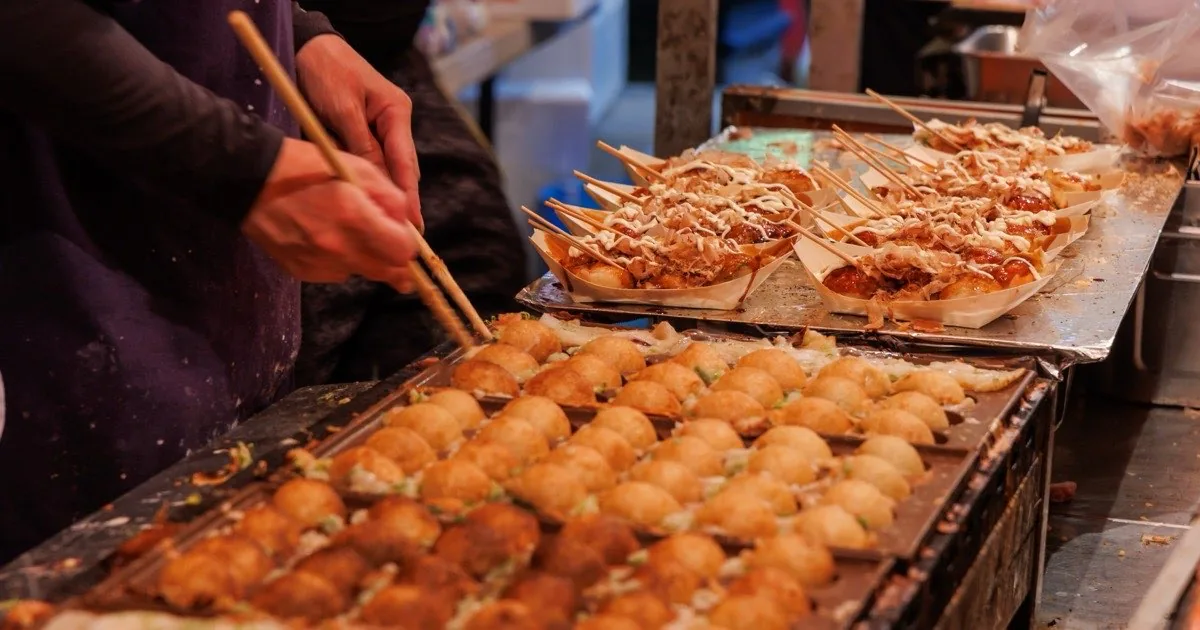
Batter balls with a piece of octopus inside, cooked in a dimpled iron plate, topped with sauce, mayonnaise, bonito flakes that move in the heat, and green seaweed powder. Six to eight for ¥400–600 from a neighbourhood stall, more like ¥500–800 on Dotonbori itself.
Here is the warning: the inside is molten. Not hot — molten. Osaka takoyaki is deliberately loose in the centre, closer to a thick sauce than a dumpling, and the first one will take the roof off your mouth if you bite it whole. Locals stab it, hold it up, and let it steam for thirty seconds. Do that. The number of visitors who burn themselves on their first takoyaki in the first hour of their trip is genuinely high.
2. Okonomiyaki, which is not a pancake
Cabbage, batter, egg and your choice of filling, griddled and finished with sauce, mayonnaise and bonito. ¥700–1,000 for a basic one, up to ¥1,500 loaded. Every English guide calls it a “savoury pancake”, which sets the wrong expectation — it is mostly cabbage, it is substantial, and one is a meal.
Many shops cook it for you on a hotplate set into your table; some hand you the bowl and expect you to do it yourself. If you get the bowl, this is not a test you can fail, and the staff will step in. Mix it, pour it, leave it alone. The single most common mistake is pressing it down with the spatula, which squeezes out the air that makes it good.
3. Kushikatsu, and the one rule you must not break
Skewered things — meat, vegetables, cheese, quail eggs — breaded, deep fried, and dipped in a thin Worcestershire-style sauce. ¥100–200 a skewer, so a full meal in Shinsekai lands around ¥1,500–3,000. It was born in Shinsekai as cheap, filling food for workers, and the best places still feel like that.
⚠️ No double dipping. This is the one piece of etiquette that will get you told off.
The sauce sits in a shared communal container on the counter. Everyone uses it. You get one dip per skewer, before you have bitten it. Dipping again after a bite is a serious breach — partly hygiene, and partly because saliva in the sauce makes it spoil. Every shop has a sign about it, usually in several languages, and staff will stop you.
The fix nobody tells you: there is a bowl of raw cabbage on the counter. It is not a garnish. Use a cabbage leaf as a scoop to ladle extra sauce onto your own plate, then dip from there as much as you like. That is what the cabbage is for, and using it correctly is the fastest way to look like you have done this before.
4. Kitsune udon, the local comfort food
Thick wheat noodles in a light broth, topped with a sheet of sweet fried tofu. Usually under ¥800. Osaka claims to have invented it, the broth here is lighter and sweeter than the Tokyo version, and it is the thing to eat when you have had three days of fried food and your body has opinions about it.
5. Ramen, with a ticket machine at the door
¥800–1,200 in most places. Osaka is not Japan’s great ramen city — that argument belongs to Fukuoka and Tokyo — but it is very good and it is everywhere. Most counter shops use a vending machine by the entrance: you pay the machine, it prints a ticket, you hand the ticket to the cook. See the ordering section below if that sounds stressful.
6. One proper izakaya dinner
An izakaya is a drinking place that serves excellent food in small plates, and it is where Osaka is at its best and most itself. Loud, warm, no ceremony. Prices vary enormously, so look at the menu posted outside before you go in, and expect a small seating charge at many places — a few hundred yen per person, which buys you a tiny appetiser you did not order. It is not a scam; it is how the system works.
Where to Eat: Dotonbori, Shinsekai and Kuromon
Three areas, three completely different experiences, and visitors routinely give all their meals to the first one.
| Area | What it is good for | When to go | Honest verdict |
|---|---|---|---|
| Dotonbori | Takoyaki, the neon, the Glico sign, the atmosphere | After dark, once | Genuinely fun and genuinely a tourist strip. Do it, then move on. |
| Shinsekai | Kushikatsu, and a rougher, older Osaka | Early evening | The best value eating of the three. |
| Kuromon Ichiba | Seafood, fruit, grazing | 8:30am, weekday | Excellent early, a crowded photo queue by lunch. |
🏠 Kuromon Market is three different markets in one day
This is the tip I give everyone and almost nobody acts on. From 5:00 to 8:00 Kuromon is still a working wholesale market, with chefs from Osaka restaurants buying for the day. Mid-morning, ordinary residents shop. By lunchtime it has turned into a grazing street for visitors, with stalls switching to single “buy and try” portions. Friday to Sunday afternoons are the peak, and on Sundays roughly 10–15% of vendors are closed — mostly the small family shops, which are the good ones.
Arrive at 8:30 on a weekday and you get the version worth seeing. Prices did rise sharply during the tourism boom, and a “reasonable pricing” scheme was introduced in August 2024 in response; the honest position is that some stalls still price for visitors. Look at what is written on the sign before you order, and buy where local shoppers are buying — they are still there, which is the reason the quality held up at all.
🏠 The two-street rule
Dotonbori is about 600 metres of continuous restaurants, and it is where every visitor eats every meal. Walk two streets north or south of the canal — towards Namba, or up into the lanes around Shinsaibashi — and the prices drop, the queues become Japanese, and the English menus disappear. That last part is the point, not the problem: a shop with no English menu and eight seats is usually a shop that survives on regulars. Point at what the person next to you is eating. It has never once gone badly for me.
How to Order When There Is No English Menu
This is the actual barrier for most visitors, and it is smaller than it looks. Three situations cover almost everything:
- The ticket machine. Common in ramen and udon shops. Put money in first, then press the button — usually the top-left button is the shop’s main dish, which is the one to order. Take the ticket, sit, hand it over. Many machines now have an English toggle in the corner.
- The counter with no menu you can read. Say osusume wa nan desu ka — “what do you recommend?” This works everywhere and is exactly what Japanese customers say. Or point at a neighbour’s plate; nobody minds.
- The picture menu. Very common in Osaka precisely because it is a tourist-heavy food city. Point and hold up fingers for how many.
Two things worth knowing: many small places are cash only, so carry some; and you do not tip in Japan, at all, ever. Leaving money on the table will get someone chasing you down the street to return it.
⚠️ Vegetarian or vegan? Read this before you order anything.
The problem in Japan is not steak, it is dashi — a stock usually made from dried bonito or sardines that flavours miso soup, simmered vegetables, dipping sauces and most broths. It is treated the way salt is treated, so a server can tell you a dish is vegetable-based in complete good faith while it sits in fish stock. Takoyaki batter and okonomiyaki batter frequently contain it too, and bonito flakes go on top of both.
Saying “I am vegetarian” is not enough. The phrase that actually works is dashi mo dame desu — “fish stock is also not okay”. Combine it: Watashi wa bejitarian desu. Niku to sakana wa tabemasen. Dashi mo dame desu. Kombu (kelp) and shiitake dashi are traditional and completely plant-based, so vegan versions genuinely exist — especially in Buddhist temple cuisine — but you have to ask specifically. Screenshot that phrase before you travel.
Is a Food Tour Worth It in Osaka?
More than in most Japanese cities, and I say that as someone generally sceptical of guided things. The reason is specific: Osaka’s best eating happens in standing bars and counter shops with no English menu and an ordering ritual you are assumed to already know. That is a real barrier, and two hours with someone who removes it changes how you eat for the rest of the trip — you spend the remaining nights walking into places you would otherwise have walked past.
If you do one, do it on your first night, not your last. The value is in what it unlocks afterwards.
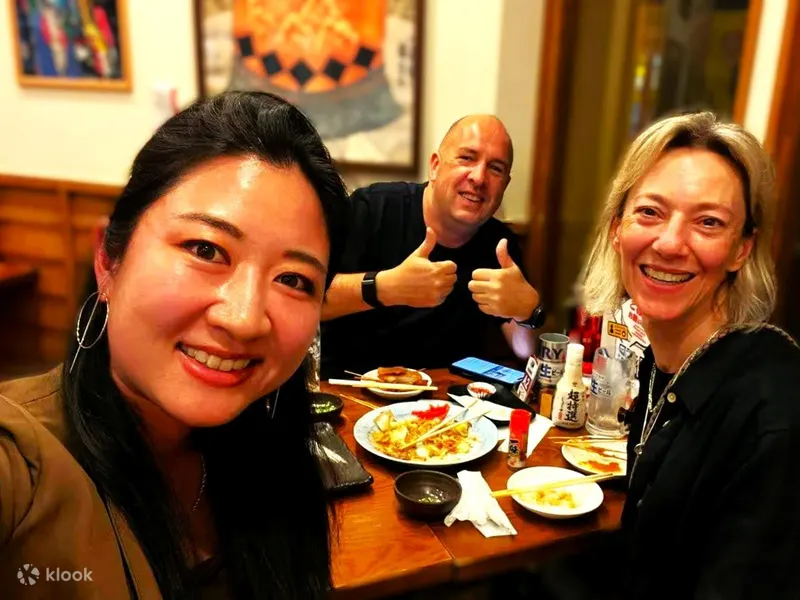
One caveat, because it matters: this kind of tour is optional. The two-hour street food walk covers the ground most first-timers actually want, but it is still paid help for something you can partly do yourself. If your budget is tight, skip tours entirely and use the two-street rule above, which costs nothing.
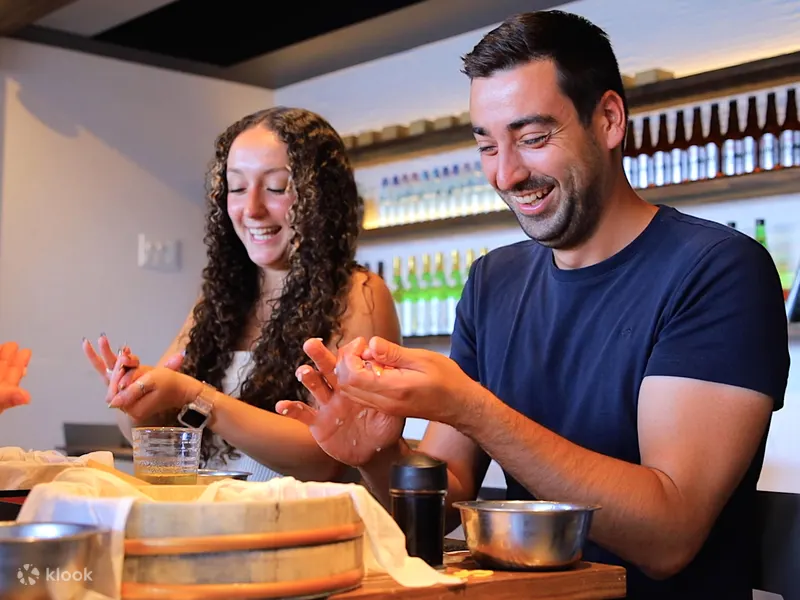
If a guided walk is not your thing, the other food experience worth booking is a sushi-making class. It solves a different problem: two hours of being shown what you are actually looking at, which changes how you read a counter for the rest of your trip. Of the Osaka food experiences we checked, this one had the strongest numbers behind it.
Take a Little of Osaka Home
These are not luxury souvenirs. They are the kinds of everyday foods that make sense after a trip: something quick for a late night, curry for a normal weeknight, and a rice topping when you want the smallest possible reminder of Japan. Check the current seller, package size and delivery date before buying.

Quick comfort food
Nissin Cup Noodles Chicken Flavor
View current Amazon page

Japanese curry
S&B Golden Curry Medium Hot
View current Amazon page

Rice topping
Mishima Nori Komi Furikake
View current Amazon page
Where to Stay If You Are Here for the Food
This matters more than people expect. Osaka’s eating happens late and on foot, and the difference between a hotel you can walk back to and one that needs a train at 11pm is the difference between two drinks and one. For a food-first trip, stay in Namba.


Full neighbourhood breakdown in Best Area to Stay in Osaka, and the head-to-head in Namba or Umeda? If you are still deciding whether to base yourself in Osaka at all, Where to Stay in Kansai compares it against Kyoto and Nara — and for a food-led trip the answer is Osaka, comfortably. One budgeting note: Osaka charges an accommodation tax per person per night, collected at the property even if you prepaid — nothing under ¥5,000, then ¥200, ¥400 or ¥500 depending on the rate. Bring cash for it.
Fitting the Food Into an Actual Trip
Do not try to eat all six things in one day; you will enjoy none of them. Two dishes a day, with walking in between, is the sustainable pace. If you are building the wider itinerary, 3-Day Osaka Itinerary for First-Timers places these meals into a route that works, and Best Klook Activities in Osaka covers the tickets side, including the Osaka Amazing Pass, which pays for itself in a day if you are doing three paid attractions.
Osaka Food FAQ
What food is Osaka famous for?
Takoyaki and okonomiyaki above all, then kushikatsu, kitsune udon and a deep izakaya culture. The city’s self-image is built on food to the point that it has a word for overspending on it, kuidaore.
How much should I budget for food in Osaka?
¥4,000–7,000 per person for a full day of grazing across the main categories. Individual items are cheap — takoyaki ¥400–600, okonomiyaki ¥700–1,000, kushikatsu skewers ¥100–200 each.
What is the rule about kushikatsu sauce?
One dip per skewer, before you bite it, because the sauce container is shared with everyone at the counter. If you want more, use a cabbage leaf from the counter bowl to scoop sauce onto your own plate. Every shop has a sign about this and staff will correct you.
When should I go to Kuromon Market?
8:30am on a weekday. It runs as a genuine wholesale market from about 5:00 to 8:00, shifts to local shoppers mid-morning, and becomes a visitor grazing street by lunch. Friday to Sunday afternoons are the busiest, and on Sundays around 10–15% of stalls close.
Is Dotonbori a tourist trap?
It is a tourist strip, and it is also genuinely enjoyable. Go once, at night, for the neon and the takoyaki. Then walk two streets away from the canal for the rest of your meals, where prices drop and the queues stop being tourists.
Do I need reservations to eat in Osaka?
Almost never. This is a walk-in city, and that is part of what makes it relaxing. The exceptions are high-end restaurants and a handful of famous places with a queue system — but for everything in this guide, you turn up.
Can I eat in Osaka as a vegetarian?
Yes, but you have to be specific, because fish stock (dashi) is in a great deal of food that contains no visible fish, including many batters and broths. Learn the phrase dashi mo dame desu — “fish stock is also not okay”. Plant-based kombu and shiitake dashi is traditional in Japan, so what you want genuinely exists.
Do I tip in Osaka restaurants?
No. Tipping is not done in Japan and leaving money behind causes confusion rather than pleasure. Many small shops are cash only, though, so carry some.
Is street food safe to eat in Osaka?
Yes. Hygiene standards are high and everything is cooked in front of you. The only real hazard is temperature — takoyaki is molten inside, and it catches almost everyone the first time.
Planning your first Japan trip? Get the free Japan Starter Guide — a simple checklist covering what to book before you arrive, where to stay in Kansai, and what most first-time visitors get wrong.