This article may contain affiliate links. If you book or buy through these links, we may earn a commission at no extra cost to you. This does not affect our recommendations. As an Amazon Associate, I earn from qualifying purchases.
Last fact-checked: 27 July 2026. Prices, tax rules and payment acceptance change — check anything that affects your budget on the day.
The thing that stops most first-time visitors from eating well in Japan is not the language. It is not knowing the sequence — where to stand, whether to pay first or last, whether to wait to be seated, and what the machine by the door is for. Get the sequence right and a shop with no English menu becomes completely accessible. Get it wrong and you hover in a doorway until you give up and go to a chain.
This guide is the sequence. It applies everywhere in Japan, and there are only really three systems to learn.
The short version
- Three systems: a ticket machine at the door, a counter where you order aloud, or a table with a menu. That is it.
- Say sumimasen to get attention. Staff will not come over on their own, and that is not rudeness — it is the system.
- Expect otoshi at an izakaya — a small dish you did not order, roughly ¥300–700 per person. It is the seating charge, not a mistake.
- You will be asked “eat in or take away?” at cafes and convenience stores. It changes the tax: 10% in, 8% out.
- Never tip. Carry cash anyway — Japan is only about 58% cashless, and the best small shops are the cash-only ones.
- System 1: The Ticket Machine
- System 2: The Counter, Where You Order Aloud
- System 3: A Table and a Menu
- The Two Charges That Surprise People
- Paying: Carry Cash, Even in 2026
- Eating Without a Common Language: What Actually Matters
- Allergies and Dietary Restrictions
- Is a Food Tour Worth It Just to Learn This?
- Where to Practise
- Ordering Food in Japan FAQ
- How do I get a waiter’s attention in Japan?
- What is the small dish I did not order?
- Do I tip in Japan?
- Why was I asked if I am eating in or taking away?
- Can I use a credit card at restaurants in Japan?
- How do ramen ticket machines work?
- Do I need reservations to eat in Japan?
- Is it rude to point at the menu?
- What should I say when I leave?
- After the Trip: Recreate the Easy Parts at Home
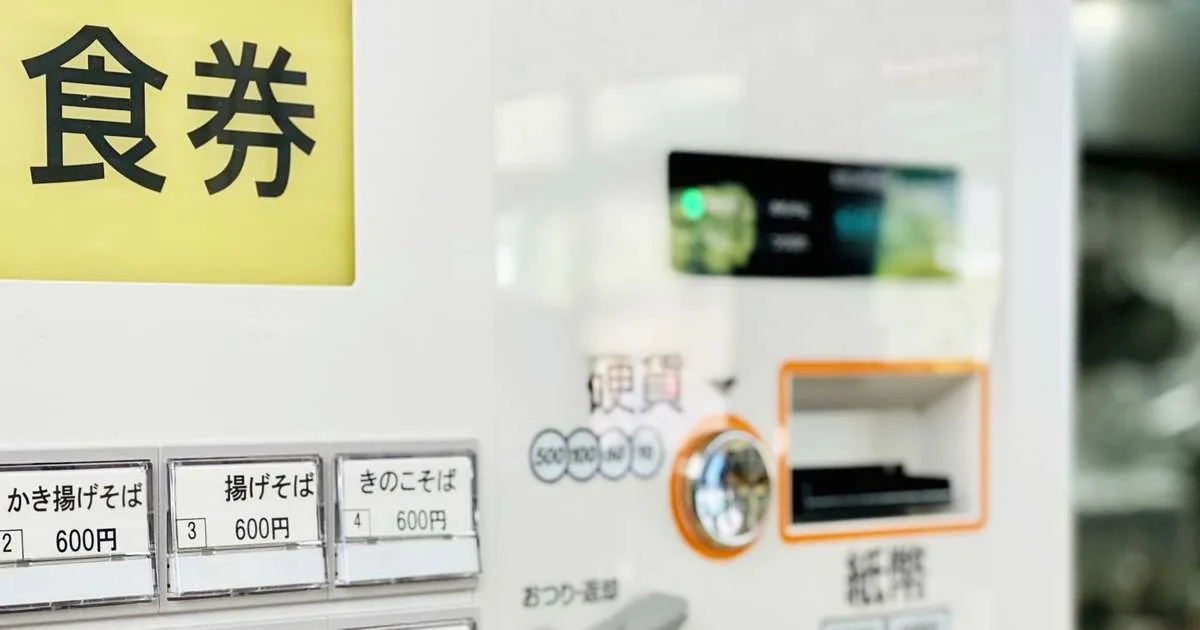
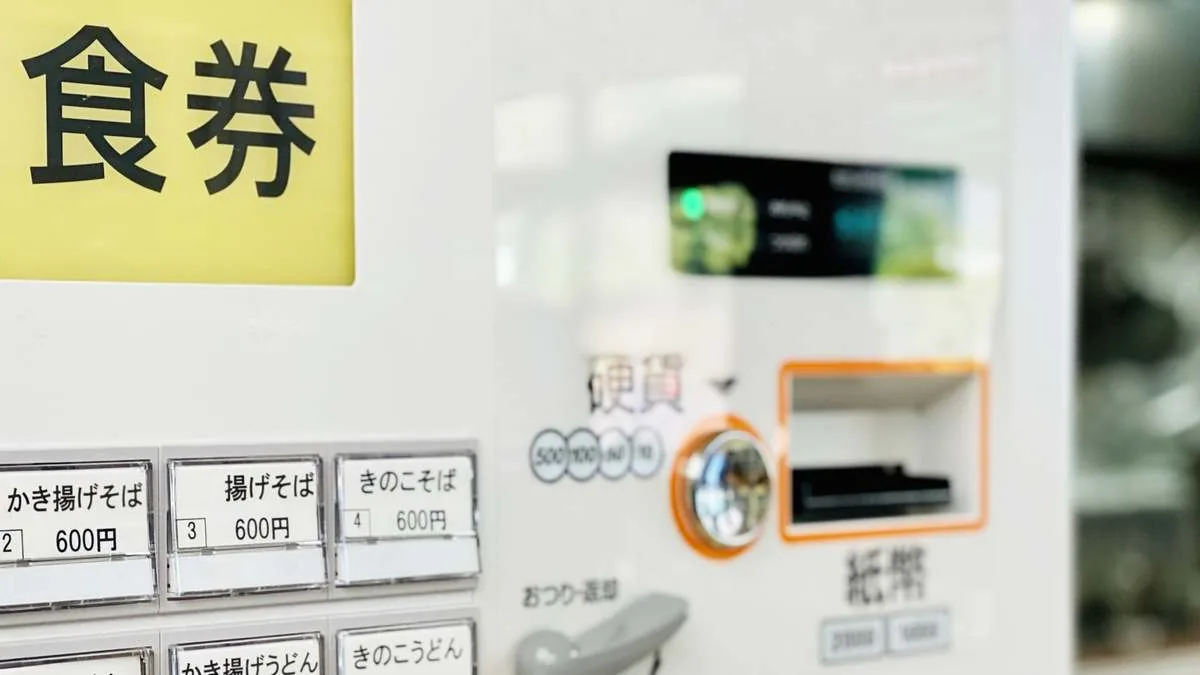
System 1: The Ticket Machine
Common in ramen, udon, soba and beef-bowl shops. It looks intimidating and it is the easiest of the three, because you never have to speak.
- Put money in first. This is the step everyone gets wrong. The buttons stay dark until the machine has your money. Coins and notes both work; most take ¥1,000 notes, many take ¥5,000 and ¥10,000.
- Press the button. The shop’s signature dish is almost always top left. If you cannot read anything, press that. It is the thing they are known for.
- Take the ticket and your change. The ticket prints out at the bottom.
- Sit down and put the ticket on the counter, face up. Staff will collect it. You have now ordered and paid, and nothing else is required of you.
- Leave when you finish. There is no bill and no waiting for a check. Just go.
Many newer machines have an English toggle in a corner of the screen — look for a small “ENG” or a flag icon before you start. Some also have photographs, which removes the problem entirely.
🏠 The two extra buttons worth knowing
Most ramen ticket machines have small buttons off to one side for toppings and extras rather than whole meals — an extra portion of noodles, a soft-boiled egg, extra pork, more spring onion. They are cheap, usually ¥100–200, and they are where regulars spend their money. Buy the egg.
There is also usually a button for ōmori, a larger portion, often at little or no extra cost. And if the machine takes your money but you cannot work out what to press, press the top-left button and stop worrying — it is the dish the shop wants to be judged on.
System 2: The Counter, Where You Order Aloud
Small izakaya, kushikatsu shops, sushi counters, standing bars. This is where the food gets genuinely good and where visitors most often lose their nerve.
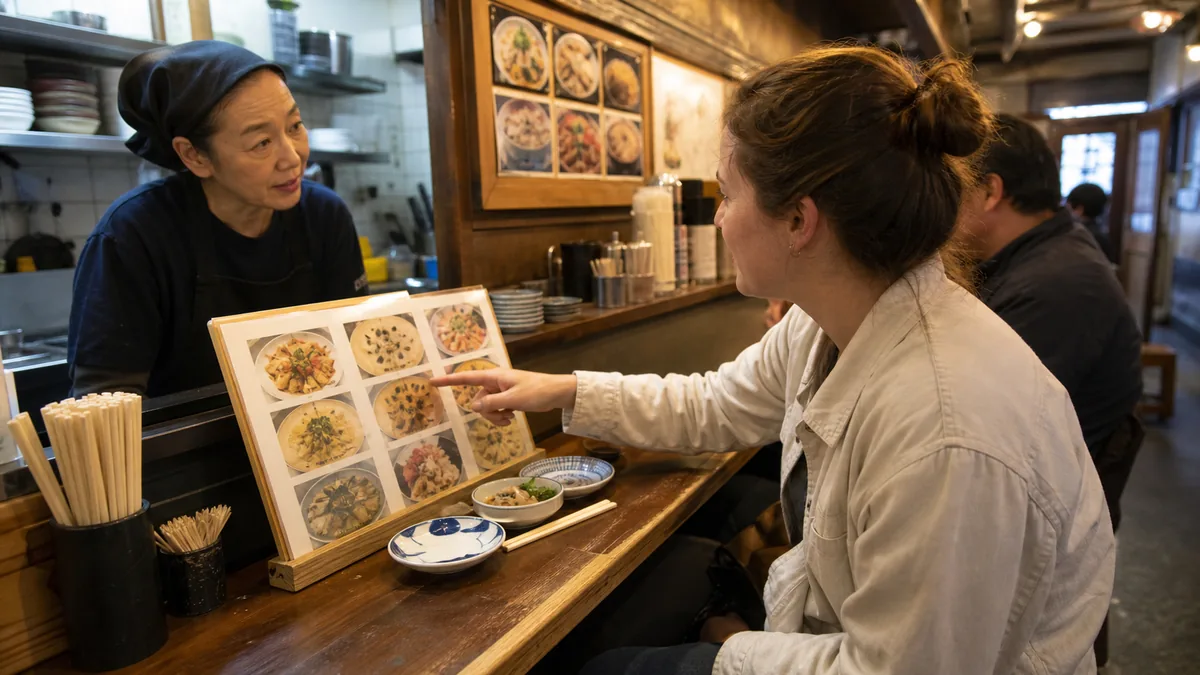
The mechanics are simple. You sit down. Nobody comes over. You say sumimasen — “excuse me” — at normal speaking volume, and someone comes. In Japan, staff waiting to be called is considered polite, not neglectful; hovering at your table is what would be rude. Visitors regularly sit for fifteen minutes assuming they are being ignored.
Then one phrase does most of the work:
| What to say | Meaning | When |
|---|---|---|
| Sumimasen | Excuse me | To call staff over. Use it constantly. |
| Osusume wa nan desu ka | What do you recommend? | The single most useful sentence in this article. |
| Kore o kudasai | This one, please | While pointing at a menu, a photo, or a neighbour’s plate. |
| Onegaishimasu | Please | Tack onto the end of anything. Always works. |
| Okaikei onegaishimasu | The bill, please | When you want to leave. |
| Gochisousama deshita | Thank you for the meal | As you walk out. Small phrase, disproportionate warmth in response. |
Pointing is completely acceptable and is not considered rude in this context. So is pointing at what the person beside you is eating. Nobody minds; if anything it is taken as a compliment to the shop.
System 3: A Table and a Menu
Family restaurants, chains, most sit-down places. Increasingly this means a tablet on the table or a QR code you scan to order from your phone, both of which usually have an English setting — which is a real argument for having data on your phone from the moment you land rather than hunting for wi-fi. Our Best eSIM for Japan guide covers that in one step.
Two conventions to know. At many restaurants you wait to be seated rather than choosing a table, and there will be a sign or a member of staff at the door. And at some places, particularly casual chains, you take your bill slip to a register by the exit and pay there rather than at the table.
The Two Charges That Surprise People
⚠️ The small dish you did not order is not a mistake — it is otoshi
Sit down at an izakaya and a small plate of something — simmered vegetables, tofu, a little seafood — will arrive without being ordered. This is otoshi, and it functions as a seating or cover charge. It typically runs ¥300–700 per person, sometimes up to ¥1,000 in smarter bars, and it is roughly 10% of what an average customer spends. It exists because people occupy seats for hours over one drink, and it is how the shop covers that.
The reason it upsets visitors is that most izakaya never mention it and there is rarely a sign. It appears on the bill at the end and reads like a bait-and-switch to anyone who does not know. It is not. It is completely standard, it is not a tip, it is not optional, and you cannot decline it by refusing the dish. Budget a few hundred yen per person and it stops being annoying — sometimes the otoshi is the best thing you eat all night.
⚠️ “Eat in or take away?” is a tax question, not a politeness question
At cafes, bakeries, fast food and convenience stores you will be asked whether you are eating in. This is not small talk. Japan runs two consumption tax rates: eating on the premises is a restaurant service and taxed at 10%, while the identical item taken away is groceries and taxed at 8%. Buy a bento at a convenience store and say you are taking it home, you pay 8%; say you will eat it at the counter inside, you pay 10%.
Answer honestly — the amounts are small and staff are not policing you, but do not sit down at the in-store counter after saying takeaway. The two words: mochikaeri (take away) and tennai de (eat in). This also quietly explains why the shelf price and the price you pay sometimes differ from what you expected.
Paying: Carry Cash, Even in 2026
Japan has moved fast on cashless payment — the ratio reached 58.0% in 2025 according to the Ministry of Economy, Trade and Industry, roughly double where it was four years earlier, with a government target of 65% by 2030. In cities, convenience stores, chains, department stores and stations take cards or contactless almost without exception.
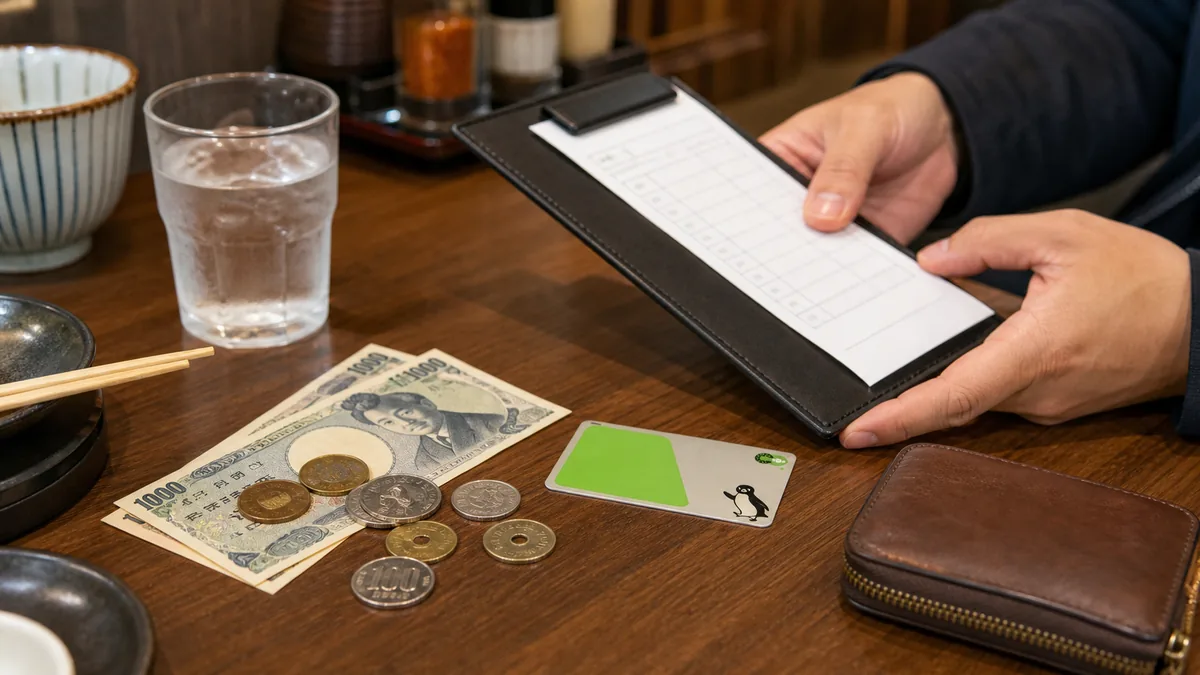
But the remaining cash economy is concentrated in exactly the places this article is trying to get you into: owner-run small shops and diners, market stalls, festival food, shrine offerings, some local buses and taxis, and the meal-ticket machines at ramen counters. The better and smaller the shop, the more likely it is cash only.
💰 The practical rule
Carry ¥10,000–15,000 in cash per person per day if you intend to eat in small places, and top up at a convenience store ATM, which accepts foreign cards and works around the clock. Keep coins — ticket machines and small shops need them, and Japan’s ¥100 and ¥500 coins accumulate fast. An IC transit card (ICOCA in Kansai, Suica in Tokyo) also works at a surprising number of food counters and vending machines, and is the fastest way to pay for small things.
Eating Without a Common Language: What Actually Matters
Most etiquette advice for Japan is overblown, and worrying about it stops people from going into places they would enjoy. Here is what genuinely matters and what does not.
| Thing | Does it matter? | What to actually do |
|---|---|---|
| Tipping | Yes — do not do it | There is no tipping in Japan. Leaving money causes confusion and someone may chase you down the street to return it. |
| Chopsticks upright in rice | Yes — avoid | It resembles a funeral rite. Rest them on the holder or across the bowl. |
| Passing food chopstick to chopstick | Yes — avoid | Same reason. Put it on a plate instead. |
| Slurping noodles | No | It is normal and expected. Slurp away. |
| The hot towel (oshibori) | Mildly | Hands only, not your face or the table. Then fold it and leave it. |
| Water and tea | No | Free, and refilled without asking. You do not pay for it. |
| Using chopsticks badly | No | Nobody is judging you. Ask for a fork if you need one — fooku onegaishimasu. |
| Eating while walking | Mildly | Generally avoided, though normal at market stalls and festivals. Eat beside the stall, not on the move. |
🏠 The one that actually changes your trip
Go in. That is the whole thing. The instinct is to keep walking past the eight-seat place with the sliding door and no English menu until you find somewhere that looks like it expects you — and that instinct will feed you a week of mediocre chain food in a country full of extraordinary small restaurants. A shop with no English menu is not hostile; it is simply a shop that survives on regulars. You will be seated, someone will find a way to help you, and the worst realistic outcome is that you eat something you did not expect. That is not a bad outcome on holiday.
Allergies and Dietary Restrictions
This is the one area where you do need to prepare, because the risk is real and the vocabulary is not obvious.
The main trap for vegetarians is dashi — a stock usually made from dried bonito or sardines that flavours miso soup, simmered vegetables, dipping sauces and most broths. It is treated the way salt is treated, so a server can tell you a dish is vegetable-based in complete good faith while it sits in fish stock. Batters and toppings frequently contain fish too.
Saying “I am vegetarian” is not enough. Say all three parts:
Watashi wa bejitarian desu. Niku to sakana wa tabemasen. Dashi mo dame desu.
“I am vegetarian. I do not eat meat or fish. Fish stock is also not okay.“
That last sentence is the one that works. Plant-based dashi made from kombu (kelp) and dried shiitake is traditional and sold in every supermarket, so what you want genuinely exists — Buddhist temple cuisine is built on it. For serious allergies, write the specific allergen in Japanese on your phone and show the screen rather than relying on a spoken exchange. Do not rely on a shop being able to check ingredients mid-service in a small kitchen.
Is a Food Tour Worth It Just to Learn This?
For some people, honestly, yes — and the reason is narrow. If the ordering barrier is what is stopping you from eating well, two hours with a guide on your first night resets the whole trip. You watch someone do it, you see that nothing bad happens, and you spend the rest of the week walking into places you would have skipped. The value is not the meal; it is what you do on the other six nights.
If you are already comfortable pointing at things and saying sumimasen, skip it and keep the money. Osaka is the city where this pays off most, because its best food is most concentrated in counter shops.
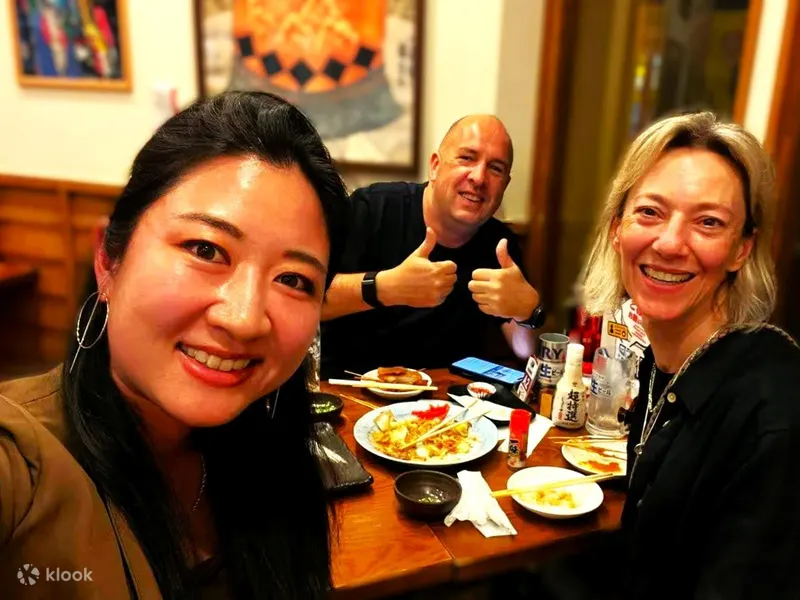
Worth saying plainly: this is not required to eat well in Japan. Use it only if the ordering barrier is what would stop you from entering small places on your own. Compare the current route, inclusions, review count and cancellation rules before you book.
Where to Practise
Osaka, without question. It is the most food-obsessed city in Japan, the most forgiving of visitors, and the one where counter culture is strongest. Our guide to what to eat in Osaka covers the six dishes worth your stomach space and what they cost, and if you are still choosing a base, Where to Stay in Kansai compares Osaka against Kyoto and Nara — for a food-led trip the answer is Osaka, comfortably.
Within Osaka, stay somewhere you can walk home from, because the good counter shops keep going late and the last train ends the evening early. Best Area to Stay in Osaka breaks down the neighbourhoods, and 3-Day Osaka Itinerary for First-Timers puts the meals into a route that actually works.
Ordering Food in Japan FAQ
How do I get a waiter’s attention in Japan?
Say sumimasen at normal speaking volume, or press the call button on the table if there is one. Staff deliberately do not hover, so waiting quietly for someone to notice you can take a very long time.
What is the small dish I did not order?
That is otoshi, a seating charge served as an appetiser at izakaya. It typically costs ¥300–700 per person and appears on the bill. It is standard practice, not a scam, and you cannot decline it.
Do I tip in Japan?
No, never, anywhere. Tipping is not part of the culture and leaving money behind is more likely to cause confusion than pleasure. Service charges at high-end places appear on the bill automatically.
Why was I asked if I am eating in or taking away?
Because it changes the tax. Eating on the premises is taxed at 10% as a restaurant service; the same item taken away is 8%. It is a legal distinction, not a preference question.
Can I use a credit card at restaurants in Japan?
In cities, chains, convenience stores and department stores, almost always. Japan’s cashless ratio reached 58.0% in 2025. But small owner-run shops, market stalls and ramen ticket machines are frequently cash only — and those are often the best places to eat. Carry cash.
How do ramen ticket machines work?
Insert money first, then press a button — the buttons do not light up until the machine has your cash. The shop’s signature dish is usually top left. Take the printed ticket to your seat and put it on the counter. You have already paid, so you can leave whenever you finish.
Do I need reservations to eat in Japan?
For most casual eating, no — ramen, izakaya, udon and market food are all walk-in. Reservations matter for high-end restaurants, and some of those will not accept a booking from someone without a Japanese phone number or a hotel concierge making the call.
Is it rude to point at the menu?
No. Pointing at a menu, a photograph, or another customer’s dish is completely normal and is often the fastest way to communicate. Combine it with kore o kudasai — “this one, please”.
What should I say when I leave?
Gochisousama deshita — “thank you for the meal”. It costs nothing, it is what Japanese customers say, and the reaction you get is out of all proportion to the effort.
After the Trip: Recreate the Easy Parts at Home
You do not need a specialist kitchen to keep the food memory going. These are simple, familiar starting points: instant noodles for a late night and furikake for rice when you want something quick. Check the current seller, package size and delivery date before buying.

Quick comfort food
Nissin Cup Noodles Chicken Flavor
View current Amazon page
Rice topping
Mishima Nori Komi Furikake
View current Amazon pagePlanning your first Japan trip? Get the free Japan Starter Guide — a simple checklist covering what to book before you arrive, where to stay in Kansai, and what most first-time visitors get wrong.